
Paris gets sold as the city of romance, and fair enough. The light is gorgeous, the bridges are pretty and there’s a bakery on basically every corner.
But there’s another side to the city that I honestly find just as interesting. Paris has been through plagues, revolutions and a couple of sieges, and it has never been shy about showing you where all of that happened.
So if you’ve already done the Eiffel Tower and the Louvre and you want something with a bit more of a story, this is for you. Some of these places are properly eerie, some are just quiet and a little sad, and all of them will tell you more about Paris than another rooftop view will.
Here are the most haunting places in Paris that are actually worth your time.
Haunting Places to Visit in Paris
The Paris Catacombs
Let’s start with the big one. The Catacombs are the reason most people go looking for the darker side of Paris in the first place, and they really do live up to it.
The story is stranger than you’d expect. By the late 1700s the city’s cemeteries were so full they had become a health problem, and the most notorious one, Saints-Innocents, was closed in 1780. At the same time, Paris was sitting on top of miles of old limestone quarries that nobody was using.
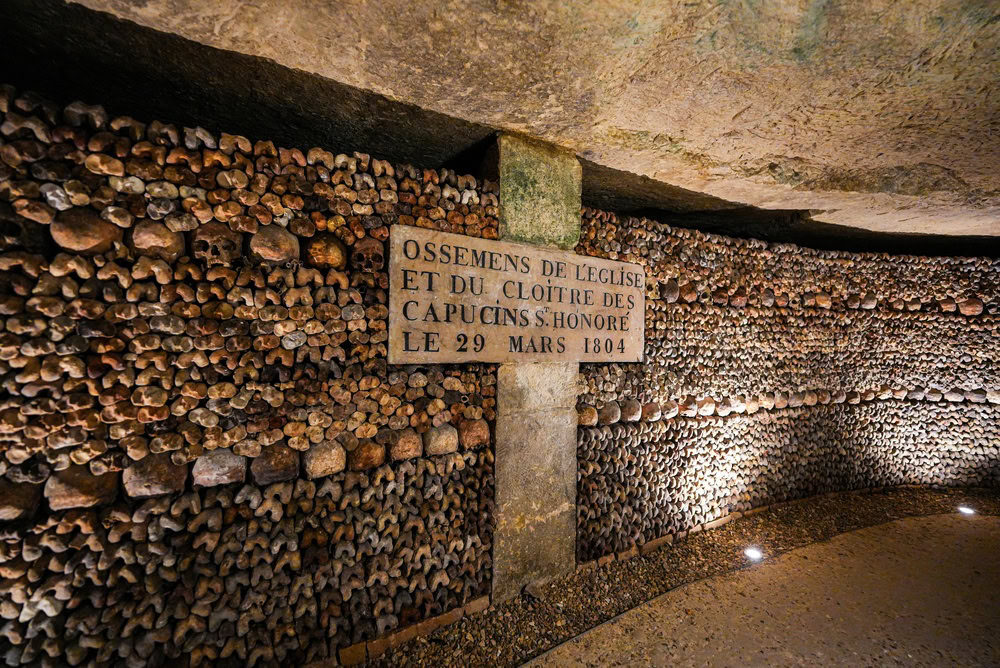
So the city put the two problems together. Starting in 1785, bones were moved from the cemeteries into the quarries, always at night. That carried on for decades, and the remains of around six million Parisians ended up down there.
What makes it so striking is that the bones aren’t just piled up. In the early 1800s a quarry inspector called Héricart de Thury had them arranged into walls, with rows of skulls set into the stacks. It’s oddly neat, which somehow makes it more unsettling.
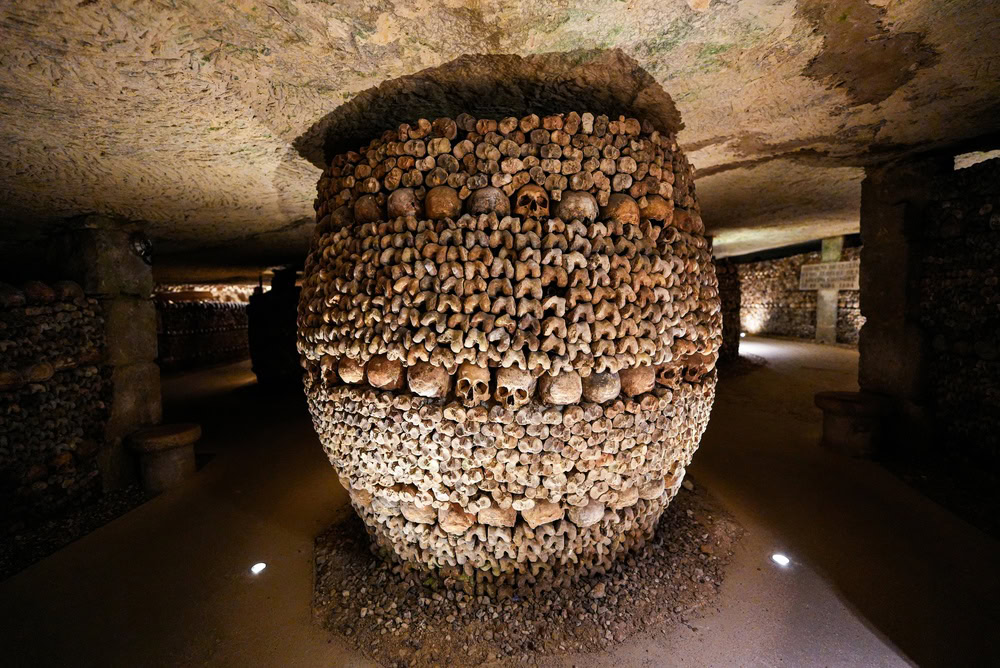
The visit takes you 20 meters underground, down 131 steps, and along about a mile of tunnels. Before you reach the bones you pass under a stone doorway carved with the words “Arrête! C’est ici l’empire de la mort”, which means “Stop! This is the empire of death”. It’s a bit theatrical, and it absolutely works.
A few practical things. It stays around 14°C (57°F) down there all year, so bring a layer even in August. There are 112 steps back up at the end, and you come out on a different street, roughly a ten minute walk from where you went in. The whole thing takes about an hour.
This is also the one place on the list you really need to plan for. It’s one of the most popular things to do in Paris, and it’s closed on Mondays. I’d book your visit to the Paris Catacombs before you travel, and pick a guided option if you want to actually understand what you’re looking at.
Père Lachaise Cemetery
Père Lachaise is the biggest cemetery in Paris and probably the most famous one in the world. It opened in 1804 on a hillside in the east of the city, and it feels more like a small town than a graveyard, with cobbled lanes, street signs and thousands of little stone chapels.
Funny enough, hardly anyone was buried here at first. The city fixed that in 1817 by moving in the remains of Molière and La Fontaine, and suddenly it was the place to be. Good marketing has always existed, apparently.
These days people come for Jim Morrison, Oscar Wilde, Chopin and Édith Piaf. Wilde’s tomb has a glass screen around it because so many visitors used to kiss the stone wearing lipstick.
It’s free to walk around, and it’s huge, so give yourself a couple of hours and wear proper shoes. Go on a gray morning if you can. It suits the place.

The Conciergerie
From the outside the Conciergerie looks like a fairytale castle on the Seine, all pointed towers and pale stone. It started life as part of the medieval royal palace, and the vaulted hall on the ground floor is one of the most beautiful Gothic rooms in the city.
Then it became a prison, and during the French Revolution it was where prisoners waited to face the Revolutionary Tribunal. For a lot of them it was the last building they ever slept in.
The most famous prisoner was Marie Antoinette. A small memorial chapel was later built on the spot where her cell stood, and it’s part of the visit.
What gets me about this place is the contrast. You walk through this grand, graceful hall and then into the rooms where people were counting down their final days. It’s right next to Sainte-Chapelle, so the two are easy to do together.

The Crypt of the Panthéon
The Panthéon sits at the top of the hill in the Latin Quarter, and most people walk in, look up at the dome and walk out again. Don’t do that. The good part is downstairs.
The crypt is where France buries the people it’s most proud of. Voltaire and Rousseau are here, along with Victor Hugo, Émile Zola and Marie Curie, who in 1995 became the first woman to be honored here for her own achievements.
It isn’t scary at all. It’s long stone corridors, low light and a lot of quiet, and you get a real sense of how seriously this country takes its writers and thinkers. If the Catacombs are about the millions of people nobody remembers, the Panthéon is the complete opposite.
Montmartre Cemetery
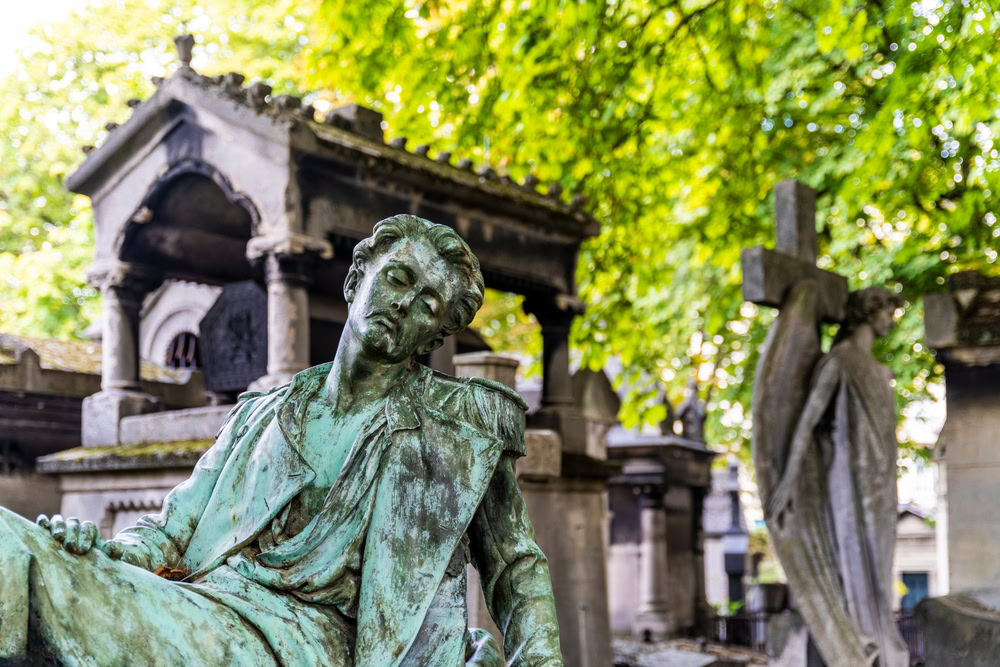
Most visitors to Montmartre head straight up to Sacré-Cœur and never notice there’s a cemetery tucked away at the bottom of the hill. It opened in 1825 in an old gypsum quarry, so it sits below street level, and there’s an iron road bridge running right over the top of some of the tombs.
That sunken setting gives it a very different mood from Père Lachaise. It’s smaller, shadier and much quieter.
Montmartre was always the artists’ neighborhood, so that’s who you’ll find here. Edgar Degas, the composer Berlioz, film director François Truffaut and the singer Dalida, whose grave is still covered in fresh flowers.
You’ll also meet the cats. A whole colony of them lives among the graves, and they tend to be stretched out on the warmest tombstones like they own the place.
What to Know Before You Go
You could see all five of these in two days without rushing. The Catacombs and Montmartre are at opposite ends of the city, so I’d split them up. Do the Catacombs and the Panthéon on one day since they’re both on the Left Bank, and save Père Lachaise for a morning of its own.
Book the Catacombs first and build everything else around that visit. The cemeteries are free and don’t need any planning at all.
Keep in mind that these are real burial places. People still visit family graves at Père Lachaise and Montmartre, so keep your voice down and be thoughtful about what you photograph. In the Catacombs, don’t touch the bones. It sounds obvious, but you’d be surprised.
And if you’re traveling with kids or anyone who doesn’t love tight spaces, think twice about the Catacombs. It’s a long stretch of enclosed tunnels, and once you’re down there the only way out is forward.
Seeing a Different Side of Paris
I think this is one of the best ways to get to know Paris properly. The pretty parts are lovely, but the city makes a lot more sense once you’ve seen where it kept its dead, its prisoners and its heroes.
Start with the Catacombs, because nothing else in Europe is quite like them. Then take a slow walk through one of the cemeteries and see how you feel. Chances are you’ll end up adding a third.
