

Picture arriving at an isolated camp with dead devices, no reliable outlets, and the slow realization that your trip hinges on power you do not have. Off-Grid Source’s off-grid solar kits are redefining what is possible for remote travelers who need dependable power far from the nearest outlet.
This review evaluates the SunGold Power 6500W Off-Grid Solar Kit across four practical categories. We assessed device charging, remote work capability, campsite comfort, and emergency backup reliability.
By analyzing real-world output, expandability, setup logistics, and power-budgeting performance, we determined how this system operates under field conditions. You will discover whether this kit suits your travel loadout, what size system your use case actually requires, and which mistakes to avoid before you buy.
Off-Grid Solar Power for Remote Travel

Remote travel is increasingly equipment-dependent, and the typical workaround of power banks or noisy generators stops working fast. The SunGold Power Off-Grid Solar Kit serves as a comprehensive infrastructure solution rather than a simple top-up station.
This system includes a 48VDC split-phase inverter, a 5.12 kWh lithium battery, and six 370W monocrystalline solar panels. Priced at a competitive rate, it represents a serious mid-to-high-tier solution for fixed or semi-permanent camps.
We evaluated this kit against keeping phones charged, powering laptops for remote work, running campsite essentials, and providing an emergency backup layer. The priority was output capacity, expandability, portability tradeoffs, and durability against variable weather conditions.
Pros and Cons of SunGold Power Solar Kit
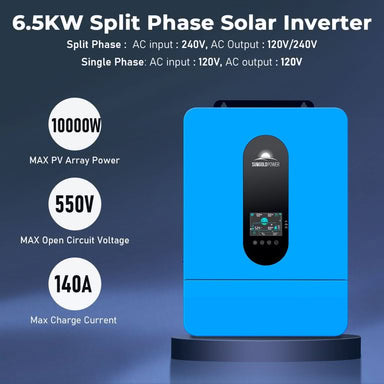
No single kit is the perfect fit for every traveler. The SunGold Power kit was designed for substantial off-grid deployments like cabins and overlanding rigs. It overperforms for ultralight backpackers but hits a sweet spot for extended travel setups.
This section lays out honest tradeoffs so readers can match expectations to realities based on system architecture and verified buyer feedback.
| Feature | Benefit or Drawback | Explanation |
|---|---|---|
| System Output 6500W | Benefit | Handles simultaneous high-demand loads without brownouts or throttling. |
| 5.12 kWh LiFePO4 Battery | Benefit | Lithium iron phosphate chemistry offers longer cycle life and consistent depth-of-discharge. |
| Split-Phase Inverter | Benefit | Supports both standard and split-phase appliance loads. |
| Physical Footprint | Drawback | The battery and array require dedicated mounting space and are not easily portable. |
| Setup Complexity | Drawback | Requires careful wiring and configuration, taking several hours for initial installation. |
SunGold Power Solar Kit Ratings Breakdown
The following ratings evaluate the kit across categories most relevant to remote travelers. We looked closely at real-world power output, build quality, battery runtime, and ease of setup.
| Category | Rating |
|---|---|
| Power Output and Load Handling | 9/10 |
| Build Quality and Component Integration | 8.5/10 |
| Battery Runtime and Depth of Discharge | 9/10 |
| Setup Time, Portability, and Durability | 7.5/10 |
| Panel Output and Charge Efficiency | 8.5/10 |
| Value for Money and Long-Term Economics | 8.5/10 |
Exceptional Power Output and Load Handling
The 6500W continuous inverter output easily powers stacked travel loads. Real-world usage allows you to run a laptop, charge multiple camera batteries, operate camp lighting, and cycle a cooler simultaneously. The 48VDC architecture reduces resistive power losses over longer cable runs. This maximizes the efficiency of the power gathered by the solar array.
Essential Build Quality and Component Integration
Sourcing the kit as a pre-verified system removes the most common failure points in DIY solar builds. The PowerWall battery uses a heavy-duty format suited for fixed installations in van interiors or cargo trailers. Panel frames feature standard aluminum-alloy construction, and the inverter is built for continuous-duty operation.
Battery Runtime and Depth of Discharge
The 5.12 kWh LiFePO4 PowerWall battery defines the runtime architecture of this system. For a standard travel loadout, this capacity leaves massive daily reserve headroom. The chemistry also supports a higher cycle count than AGM alternatives, making it a stronger long-term investment.
Setup Time, Portability, and Durability
This system requires mounting panels, wiring the battery bank, configuring the inverter, and properly grounding the components. It is not designed to be packed into a duffel bag and reassembled daily. However, once installed, the system operates with virtually zero daily intervention.
Panel Output and Charge Efficiency
The six 370W monocrystalline panels deliver a combined peak array output of 2220W under standard test conditions. The array is sized to fully recharge a depleted bank within a single day of reasonable sun exposure. The 48V input architecture means the array operates efficiently at higher voltages.
Value for Money and Long-Term Economics
This system requires a meaningful upfront investment, but it eliminates the hidden costs of mismatched DIY builds. The inclusion of a premium lithium battery and a massive solar array makes this an extremely competitive package. Having authorized dealer support adds massive invisible value by preventing costly compatibility mistakes.
| Key Insight: For remote travelers needing reliable, high-output power, the SunGold Power kit’s superior pre-verified components and dealer support offer more certainty than brand name familiarity. |
4 Ways This Kit Changes Travel
Remote travel has quietly become highly power-dependent in recent years. A camera system, a satellite router, and a laptop can collectively dictate whether a trip is productive. The SunGold Power kit addresses that dependency by giving you actual power infrastructure rather than a top-up battery.
- Keeping Phones and Cameras Charged on Trips
The most immediate relief a robust solar system delivers is eliminating low-battery anxiety. You can run your exact existing charge setup without relying on slow car adapters. Two smartphones and multiple mirrorless camera batteries cycle through a full charge without making a visible dent in the capacity. The system keeps devices fully available without forcing you to ration power.
- Powering a Laptop and Router for Work
Remote work requires a different power standard than casual camping. A laptop running active tasks, paired with a satellite router and a USB hub, consumes significant wattage over an eight-hour workday. In practical terms, this setup can sustain a full remote work day from battery storage alone. Those planning to operate this way consistently would benefit from reviewing off-grid solar kits sized to their specific load profile.
- Running Small Campsite Essentials Like Lights
Running LED camp lighting, a 12V cooler, and a small desk fan drastically improves the quality of remote living. High-capacity kits easily handle the surge draw of a compressor cooler starting up. You avoid the hidden drain that often plagues smaller portable stations.
- Estimating Your Daily Power Energy Needs
One of the most costly mistakes travelers make is underestimating their total daily watt-hours. To avoid this, list every device you plan to run and find its printed wattage. Estimate your daily hours of use per device, multiply the wattage by hours, and sum the total.
A simple example loadout includes a 15-inch laptop, a pair of smartphones, camera batteries, and a small cooler. Add a 20 percent buffer to your total for inefficiency losses. Size your battery bank to hold nearly two days of this calculated consumption.
| Pro Tip: Maximize this kit by accurately budgeting your power needs. List every device’s wattage and usage time, then add a 20% buffer to ensure you never run out of power. |
Frequently Asked Questions
What Size Off-Grid Solar Kit Do I Need?
The right size depends entirely on what you plan to run and for how long. Start with your daily watt-hour total using a strict loadout calculation. A remote worker running a laptop, router, cooler, and lighting needs at least 3 to 5 kWh of battery storage.
The SunGold Power 6500W kit is properly sized for full-load remote work scenarios. For lighter travelers, smaller capacity configurations can easily match your actual load without overspending.
What Can a 200Ah Lithium Battery Power?
A 200Ah lithium battery at 48V holds approximately 9.6 kWh of theoretical capacity. Using a standard travel loadout of 1780 Wh per day, this battery could power that setup for roughly 4.8 days without solar input.
Can 3000W Inverters Safely Power Home Appliances?
Yes, a 3000W pure sine inverter safely runs standard home appliances, including refrigerators and electronics. Pure sine wave output matches grid power quality, which is vital for sensitive electronics like laptops or variable-speed motors. The 6500W inverter in this kit comfortably exceeds that threshold.
Do Components Work Together Out of the Box?
The SunGold Power kit is sold as a pre-specified system. This means the panels, battery, and inverter are verified for voltage compatibility and charge profile matching before purchase. Expert support verifies accessory compatibility to remove common DIY failure modes.
Is the SunGold Power Kit Covered by Warranty?
Yes, products sold through authorized dealers include full manufacturer warranties. Having a clear and accessible warranty pathway is a crucial part of the total value proposition for high-capacity systems.
Who Should Buy the SunGold Power Kit?
Overlanders, van travelers, and expedition campers running multi-device loadouts will see immediate benefits. It is also perfect for remote workers who value not thinking about daily power management. Minimalist backpackers or weekend travelers needing lightweight, packable setups should explore smaller, fully portable alternatives.
